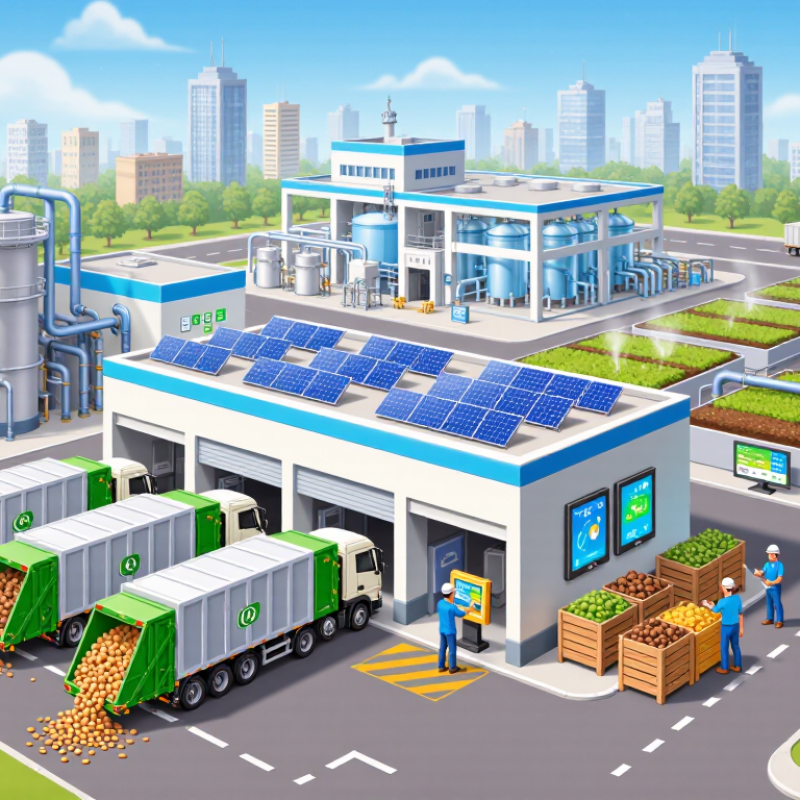
China’s organic waste management sector is entering a more practical and data-driven phase. Cities are expanding food-waste separation, anaerobic digestion, composting, and biogas recovery. These systems turn kitchen scraps, agricultural residues, and sludge into renewable energy, soil amendments, or industrial feedstocks. In Shanghai, collection vehicles increasingly use sealed containers and digital route monitoring to reduce leakage and odors. Similar practices are influencing technology investment across other major urban regions.
The strongest trend is integration. Smart weighing systems track incoming waste, while sensors monitor moisture, temperature, methane levels, and contamination inside treatment facilities. Anaerobic digesters can produce biogas for electricity or upgraded biomethane. Composting plants use forced aeration and controlled fermentation to improve stability. Yet technology alone cannot solve poor source separation. Plastic fragments, excessive moisture, and unstable markets still weaken operating results. That reality deserves attention.
So, what is the future of organic waste management technology? It may depend on combining reliable equipment, local operating experience, transparent data, and stronger end-product markets. China’s large cities offer valuable field evidence, but performance differs by climate, feedstock quality, and management capacity. Some projects appear impressive during construction, then struggle with maintenance costs. This is a useful warning. Future solutions should be evaluated through long-term performance, emissions control, worker safety, and measurable resource recovery. Such a balanced approach can help policymakers, investors, and facility operators identify the most credible organic waste technologies shaping China’s next stage.
Definition and Scope of Organic Waste Management in China
Organic waste management in China covers the collection, treatment, recovery, and safe disposal of biodegradable materials. The scope includes household kitchen waste, agricultural straw, livestock manure, food-processing residues, garden waste, and sewage sludge. These materials differ greatly in moisture, contamination, and energy value. A wet kitchen-waste load may contain more than 70% water, while dry straw requires separate storage and pretreatment.
Official statistics show the scale clearly. The Ministry of Agriculture and Rural Affairs reported a national crop-straw comprehensive utilization rate of about 88% in 2022. The Ministry of Housing and Urban-Rural Development also recorded more than 240 million tonnes of municipal household waste collected in urban areas during 2022. These figures do not represent organic waste alone, but they reveal the pressure placed on sorting and treatment systems. Food waste remains especially difficult because plastics, bones, oils, and packaging often arrive together.
In practice, China’s management scope is moving beyond disposal. Anaerobic digestion, composting, aerobic fermentation, and biomass recovery are increasingly assessed by emissions, soil safety, and product quality. The 14th Five-Year Plan promotes resource recovery from kitchen waste and agricultural residues. Yet reported utilization rates can hide regional differences and inconsistent measurement. Rural collection remains uneven. Data quality needs improvement. A credible system should therefore track material flows from the household bin to the final digestate, compost, fuel, or disposal site.
China’s organic waste collection is moving toward cleaner separation at the source. The World Bank’s What a Waste 2.0 report estimates that food and green waste represent 44% of global municipal waste. This makes collection design more important than simply adding treatment capacity. In practice, sealed kitchen-waste bins, washable transfer containers, and scheduled collection can reduce leakage and odors near apartment compounds. Smart weighing systems also record route volumes and contamination rates. Useful data, but not always perfect.
Sorting quality remains the difficult step. Optical scanners can identify visible plastics, while magnetic separators remove ferrous materials from mixed loads. However, wet food waste often sticks to packaging and lowers machine accuracy. Manual inspection is still needed at transfer stations. The UNEP Food Waste Index Report 2024 estimated 1.05 billion tonnes of food waste in 2022, with households generating 60%. That figure supports local collection campaigns, but household behavior differs sharply between dense cities and smaller communities. China’s separate kitchen-waste systems therefore need flexible schedules, clear bin labels, and neighborhood-level monitoring. A single national operating pattern may be efficient on paper, yet unsuitable on the ground. Data should guide decisions, not replace field experience.
China’s organic waste sector is moving toward anaerobic digestion and biogas recovery systems. These systems treat food waste, livestock manure, and wastewater sludge inside oxygen-free digesters. Microorganisms break down the material and produce biogas, mainly methane and carbon dioxide. The recovered gas can support heating, electricity generation, or upgraded renewable gas.
Practical performance depends on feedstock quality and daily operation. Food scraps may contain plastics, salt, or cleaning chemicals, so sorting and pre-treatment are essential. Stable temperature, moisture, and loading rates help prevent sudden process failure. Field experience shows that digesters rarely perform well through equipment alone. Operators must check gas pressure, hydrogen sulfide, pH, and digestate quality. Maintenance remains a weak point. Small mistakes can reduce gas output for weeks.
Tips: Start with a reliable waste survey. Measure seasonal volumes before sizing the digester. Keep kitchen waste free from packaging. Use gradual feeding during commissioning. Test digestate before agricultural use, because nutrient levels can vary. Record methane production every day. A simple logbook often reveals problems earlier than expensive monitoring software. Operators should also plan for low-output periods, since winter temperatures and changing waste composition can reduce recovery efficiency.
China’s organic waste sector is moving from simple disposal toward composting and biofertilizer production. The Ministry of Agriculture and Rural Affairs reported a crop-straw comprehensive utilization rate above 88% in 2023. This figure shows progress, but not complete resource recovery. Moisture, contamination, and unstable collection still reduce practical value.
Well-managed composting needs a carbon-to-nitrogen ratio near 25–30:1. Moisture should usually remain around 50–60%. Piles should reach 55–65°C for several days, supporting pathogen reduction. Operators often turn piles when oxygen falls or odors increase. The process is not perfectly uniform. Dense wet pockets can remain cold. That weakness needs routine temperature mapping, not visual guessing.
Mature compost can be screened, tested, and blended into biofertilizer products. China’s National Organic Fertilizer Standard requires controls for indicators such as moisture, organic matter, nutrients, pathogens, and heavy metals. The 2022 China Rural Statistical Yearbook also highlights the growing scale of livestock and crop production, creating a large feedstock base. However, high volume does not guarantee high quality. Feedstock separation, laboratory sampling, and maturity testing remain essential. More facilities should record oxygen, temperature, electrical conductivity, and germination results across each batch. Better data could reduce failed applications and build farmer confidence.
The chart compares typical operating temperature ranges used in organic waste treatment and biofertilizer production. Thermophilic composting and thermophilic anaerobic digestion support pathogen reduction, while mesophilic digestion is widely used for stable biogas production. Vermicomposting operates at lower temperatures and is generally applied after partial stabilization of the feedstock.
Organic waste management is moving from collection records to live, data-driven control. The UNEP Food Waste Index Report 2024 estimates that 1.05 billion tonnes of food were wasted in 2022. Households generated about 60% of it. This scale is pushing cities toward digital weighing, route optimization, and container sensors. A smart bin can flag unusual weight changes before odors spread. QR-based tracking can also connect restaurant scraps with composting or digestion facilities. However, digital tools are not magic. Poor data still produces confident mistakes.
Circular systems are becoming more practical. Anaerobic digestion converts separated food waste into biogas and nutrient-rich digestate. Composting returns stable organic matter to soil. The technology works best when contamination stays low. A single plastic bag can reduce the value of an entire batch. The World Bank’s What a Waste 2.0 report projected global waste generation could reach 3.40 billion tonnes by 2050, up from 2.01 billion tonnes in 2016. Organic fractions will remain a major pressure point.
Emerging platforms now combine moisture sensors, machine vision, and predictive maintenance. Operators can adjust oxygen, temperature, and mixing instead of relying only on fixed schedules. Circular procurement is also gaining attention, especially for certified compost and recovered nutrients. Yet measurement remains uneven across regions. The Circularity Gap Report 2024 placed global circularity at only 7.2%. That figure deserves caution, but it exposes a real weakness: many systems track waste movement better than resource recovery. Practical progress may depend less on futuristic hardware and more on clean separation at the kitchen door.
Technology trends, measurable indicators, policy signals, and circular-economy applications
| Trend Area | Core Technologies | Key Data Dimension | China-Related Data or Policy Signal | Circular-Economy Value | Development Outlook |
|---|---|---|---|---|---|
| Source Separation and Organic Waste Collection | Four-stream sorting, separate kitchen-waste bins, sealed collection vehicles, RFID identification, and weighing systems | Separation rate, contamination rate, collection coverage, route efficiency, and source-to-facility traceability | China’s revised Solid Waste Pollution Prevention and Control Law took effect on September 1, 2020, providing a legal framework for domestic-waste classification and separate collection. | Cleaner organic feedstock improves anaerobic digestion, composting, and biofertilizer quality while reducing landfill disposal. | High Further progress depends on household participation, commercial-source separation, and consistent enforcement. |
| Digital Monitoring and Smart Waste Operations | IoT sensors, GPS fleet tracking, cloud platforms, GIS route optimization, electronic manifests, and dashboard analytics | Real-time tonnage, moisture content, contamination alerts, vehicle utilization, route distance, and facility throughput | Digitalization supports China’s broader smart-city, urban sanitation, and waste-classification programs; the national legal framework also emphasizes supervision across collection, transport, and treatment. | Improves operational transparency, reduces unnecessary transport mileage, and creates auditable material-flow records. | High Digital tools are moving from basic weighing and GPS toward predictive maintenance and AI-assisted quality control. |
| Anaerobic Digestion and Biogas Recovery | Wet anaerobic digestion, co-digestion, biogas upgrading, combined heat and power, and digestate treatment | Organic loading rate, methane yield, volatile-solids reduction, energy recovery, digestate quality, and fugitive-methane control | Anaerobic digestion is recognized in China’s waste-treatment and agricultural-resource-utilization policies as a route for recovering energy and nutrients from food waste, manure, and other biodegradable materials. | Converts biodegradable waste into renewable gas, electricity, heat, and nutrient-containing digestate. | High Growth is strongest where stable feedstock supply, odor control, and digestate outlets are available. |
| High-Solids Composting and Biological Treatment | Aerated static piles, windrow composting, in-vessel composting, forced aeration, biofilters, and automated temperature control | Moisture, carbon-to-nitrogen ratio, oxygen concentration, temperature profile, pathogen reduction, maturity, and odor emissions | Composting remains an established treatment option for agricultural residues, garden waste, and selected source-separated organic waste streams under China’s waste-reduction and soil-improvement policies. | Produces soil amendments and compost, returns organic carbon to soil, and reduces dependence on landfill disposal. | Medium to High Market acceptance depends on consistent feedstock quality and verified product standards. |
| Food-Waste Pre-Treatment and Contamination Removal | Depackaging, shredding, pulping, screening, grit removal, magnetic separation, and automated impurity detection | Plastic and metal contamination, solids recovery, slurry concentration, equipment wear, and pre-treatment energy use | Separate kitchen-waste collection has increased the need for robust pre-treatment because food waste commonly contains packaging residues, plastics, glass, and other non-organic materials. | Protects downstream digesters and composting systems while improving the quality of recovered organic products. | High Automation is increasingly important for large urban facilities with variable incoming waste quality. |
| Nutrient Recovery and Digestate Valorization | Solid-liquid separation, ammonia recovery, struvite precipitation, drying, pelletizing, and quality-controlled biofertilizer production | Nitrogen, phosphorus, potassium, organic matter, heavy metals, salinity, pathogens, and product acceptance | China’s circular-economy and agricultural-resource-utilization policies promote the return of organic nutrients to farmland, subject to environmental and product-quality controls. | Reduces nutrient losses and supports replacement of part of the demand for mineral fertilizers and soil conditioners. | Medium to High Expansion requires reliable quality testing, traceability, and safe end-use management. |
| Agricultural Organic-Waste Recycling | Livestock-manure anaerobic digestion, composting, straw utilization, aerobic fermentation, and integrated crop-livestock systems | Manure collection rate, treatment capacity, nutrient-use rate, odor reduction, greenhouse-gas emissions, and farmland application | China’s agricultural policies promote resource utilization of livestock manure and crop residues, linking waste treatment with soil health, rural development, and agricultural pollution control. | Creates a closed loop between farms, organic fertilizers, soil improvement, renewable energy, and crop production. | High Integrated regional systems are more viable than isolated treatment plants because they improve nutrient and energy matching. |
| Carbon Accounting and Methane-Emission Control | Methane leak detection, enclosed treatment, biogas flare monitoring, carbon accounting, life-cycle assessment, and emissions data platforms | Methane capture rate, direct emissions, energy substitution, avoided landfill emissions, carbon intensity, and verified reduction volume | China’s carbon-peaking and carbon-neutrality goals are increasing attention to methane management, renewable-energy recovery, and greenhouse-gas accounting in the waste sector. | Turns emissions management into measurable climate performance and supports low-carbon infrastructure planning. | High Monitoring quality and standardized accounting will determine the credibility of reported reductions. |
| Regional Circular-Waste Hubs | Integrated transfer stations, organic-waste treatment parks, co-digestion, composting, wastewater co-treatment, and material-flow platforms | Facility utilization, transport radius, treatment cost per tonne, energy balance, product sales, and regional diversion rate | China’s circular-economy planning encourages coordinated use of waste, energy, water, and material infrastructure instead of treating each waste stream in isolation. | Enables synergies among food waste, agricultural residues, wastewater sludge, green waste, renewable energy, and recovered nutrients. | High Regional planning can reduce duplicated infrastructure and improve the economic stability of treatment facilities. |
| Resource-Recovery Performance Management | Digital mass-balance models, quality tracking, predictive analytics, automated laboratory systems, and performance-based contracts | Waste diversion, resource-recovery yield, renewable-energy output, operating cost, product quality, and compliance rate | China’s 14th Five-Year Plan for circular-economy development set a national target for the circular-economy industry to reach approximately RMB 5 trillion in output value by 2025; this target covers the wider circular-economy sector, not organic waste alone. | Shifts evaluation from simple disposal volume toward measurable recovery of energy, nutrients, materials, and carbon benefits. | High Standardized indicators will improve comparison among cities, facilities, and treatment pathways. |
It includes kitchen waste, crop straw, livestock manure, food-processing residues, garden waste, and sewage sludge. These materials vary greatly.
Food waste often arrives with plastics, bones, oils, and packaging. A wet load may contain over 70% water. Separation matters.
Urban areas collected over 240 million tonnes of household waste in 2022. This figure includes more than organic materials.
A carbon-to-nitrogen ratio near 25–30:1 supports stable composting. Moisture should usually remain between 50% and 60%.
Compost piles should reach 55–65°C for several days. This supports pathogen reduction. Cold pockets can still remain.
They should record temperature, oxygen, moisture, and odors across different pile locations. Visual inspection alone is not enough.
Mature compost can be screened, tested, and blended into biofertilizer. Testing should cover nutrients, moisture, pathogens, organic matter, and heavy metals.
No. Reported rates may hide regional differences and inconsistent measurement. Data can mislead. Material tracking needs improvement.
Rural collection remains uneven, and feedstock separation is inconsistent. This can reduce product quality and increase failed applications.
It should follow materials from the household bin to compost, digestate, fuel, or final disposal. The chain is not always complete.
China’s organic waste management sector is evolving from basic disposal toward integrated resource recovery. It covers the collection, transportation, sorting, treatment, and reuse of food scraps, agricultural residues, garden waste, and other biodegradable materials. Improved separation systems, enclosed collection equipment, and automated sorting can reduce contamination and increase the value of recovered materials. These measures create a stronger foundation for safe and efficient treatment across cities and rural areas.
Anaerobic digestion is becoming an important solution for converting organic waste into biogas and nutrient-rich digestate, while composting can transform suitable materials into soil amendments and biofertilizers. Future development will likely focus on cleaner processes, better odor and pollution control, and higher-quality product standards. Digital platforms, sensors, data analysis, and intelligent scheduling can improve operational efficiency and traceability. At the same time, circular management models can connect households, farms, processors, and energy users. In considering what is the future of organic waste management technology, the answer lies in combining digital innovation, biological treatment, renewable energy recovery, and practical local resource cycles.

AgBio Energy