Understanding what is organic waste composting and how does it work is essential before comparing China’s top 10 composting machines. Organic composting transforms food scraps, crop residues, manure, and green waste into a stable soil amendment. Microorganisms consume carbon-rich and nitrogen-rich materials. They release heat, water vapor, and carbon dioxide during decomposition.
Dr. Sally Brown, a research professor and respected composting expert, describes compost as “a resource, not a waste.” This principle guides modern equipment design. In-vessel composters, fermentation machines, windrow turners, and aerobic composting systems control airflow, moisture, temperature, and mixing. A machine may shred kitchen waste first, then blend it with dry bulking materials such as sawdust or rice husks. Moisture matters. Excess water creates odors and slows oxygen movement. Too little moisture can stop microbial activity.
The best systems do not simply hide waste inside a steel chamber. They create suitable conditions for biology. Temperatures commonly rise during active composting, while regular turning or forced aeration supplies oxygen. Sensors can monitor heat and moisture, but operators still need practical judgment. A display cannot always detect uneven mixing or contaminated feedstock. That is an important limitation.
This guide examines ten Chinese organic waste composting machines, focusing on capacity, processing time, energy use, odor control, maintenance, and finished-compost quality. Some machines appear highly automated. Others require more manual supervision. Buyers should compare real operating conditions, not only brochure specifications. Composting is not instant. It is a managed biological process with useful imperfections, visible heat, earthy smells, and occasional failed batches.
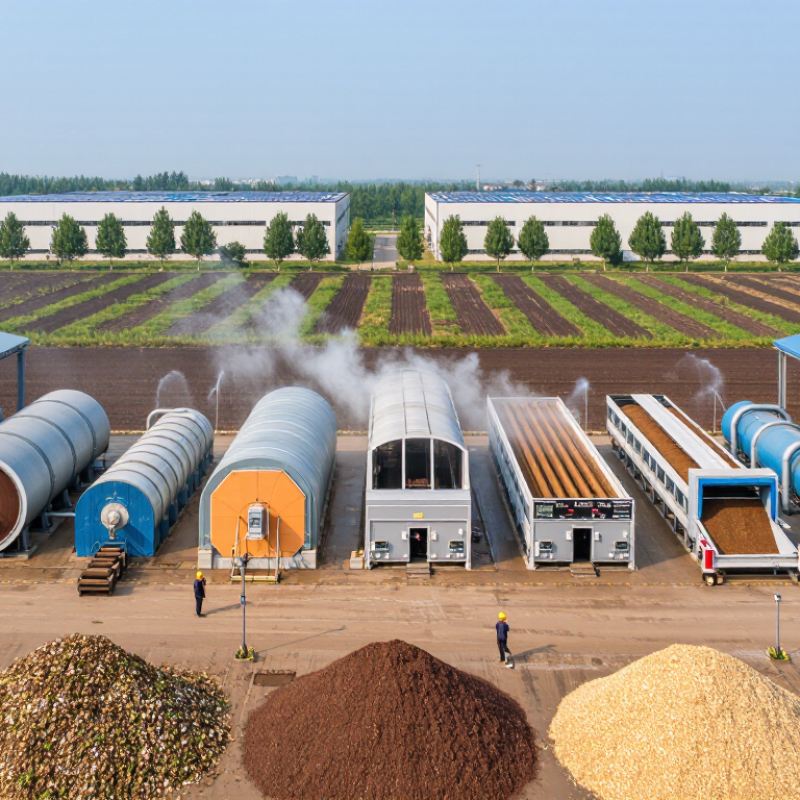
Organic Waste Composting Machines: Purpose, Types, and Core Components
Organic waste composting machines turn food scraps, leaves, and agricultural residues into usable compost. They control moisture, airflow, temperature, and mixing inside an enclosed chamber. This process reduces odors and shortens decomposition compared with unmanaged piles. However, the machine cannot correct badly sorted waste. Plastic film and excess oil still create problems.
Common types include aerobic composters, in-vessel systems, fermentation units, and rotary drum composters. Aerobic models use oxygen-loving microbes and usually need regular aeration. In-vessel machines offer stronger control for restaurants, markets, and institutions. Rotary drums mix material continuously, while fermentation units operate with limited oxygen. Each type suits different waste volumes, site conditions, and operating skills.
Core components often include an insulated chamber, mixing blades, ventilation fans, heating elements, temperature sensors, and a control panel. Some systems also use odor filters and drainage collection tanks. Operators should check moisture by hand; the material should feel like a wrung-out sponge. A temperature near 50–65°C usually supports active aerobic decomposition, but readings need context. My practical concern is simple: automation can encourage careless loading. A wet batch may become dense and smell sour. A dry batch may stop decomposing. Regular inspection remains essential, even with accurate sensors and programmed cycles.
Organic waste composting machines turn food scraps, leaves, and farm residues into stable compost through controlled biological activity. Operators begin by removing plastic, glass, stones, and other contaminants. Sorting quality matters. A machine cannot correct careless preparation.
The waste then enters a shredder, where blades reduce large pieces into smaller particles. Smaller pieces expose more surface area to microbes. A mixer combines the material with dry bulking agents, such as sawdust or chopped straw. This balances moisture and air space. The mixture should feel damp, not dripping. Too much water can create foul odors and slow decomposition.
Inside the composting chamber, microbes produce heat while breaking down organic matter. Sensors track temperature, moisture, and oxygen levels. Fans or turning systems move air through the material. In practical operation, technicians still inspect texture and smell because sensors can drift. The temperature may rise unevenly, especially when the feedstock is poorly mixed. That part needs patience. After active treatment, the material rests in a curing area, where remaining fibers stabilize. A screen removes oversized pieces, which can return to the next batch. Operators often adjust the cycle after each load because seasonal waste changes its moisture and structure.
China’s Top 10 Organic Waste Composting Machines and Their Main Features
China’s leading organic waste systems cover ten useful machine types. A dewatering machine removes excess liquid from food waste. A crusher reduces kitchen scraps and green waste into smaller pieces. An in-vessel composter uses enclosed aeration and controlled heating. A fermentation tank supports rapid aerobic decomposition in a sealed chamber. A drum composter mixes material continuously and saves floor space. A groove turner moves along fixed compost channels and suits medium-scale facilities. A windrow turner mixes long outdoor piles with rotating paddles. A crawler turner travels across uneven ground and handles large volumes. A rotary screening machine separates finished compost from oversized pieces. A biofilter unit treats air from enclosed equipment and reduces unpleasant odors.
In practice, machine selection depends on moisture, feedstock, space, and daily capacity. Operators should check temperature records, oxygen supply, and material texture, not only advertised output. For example, wet food waste may need dewatering before entering a fermentation tank. Dry leaves may require added moisture and a stronger mixer. Small sites often prefer drum or in-vessel designs because they need less land. Large farms may choose windrow or crawler turners for lower operating costs. Maintenance also matters. Clean air pipes, inspect bearings, and remove trapped fibers regularly. Simple work. Yet, no machine performs perfectly with mixed materials. Plastic contamination can damage crushers and screens. Odor control may also weaken during overloaded batches. Field trials, service access, and operator training deserve careful attention before purchase.
China’s top ten organic waste composting machines differ sharply in capacity, process control, energy use, and compost quality. Small in-vessel units often handle 0.5–5 tonnes daily, while continuous systems may process over 100 tonnes. The UNEP Food Waste Index 2024 estimated 1.05 billion tonnes of food waste worldwide in 2022, increasing demand for compact treatment equipment.
Technology changes the final material. Aerated static systems use fans and perforated floors, while rotary and enclosed tunnel machines improve mixing and temperature control. Some field studies report electricity use near 20–80 kWh per tonne, depending on moisture, grinding, aeration, and residence time. That range is wide. Operators should measure actual consumption, not trust catalogue estimates. The IEA Bioenergy reports that biological treatment performance depends heavily on oxygen supply and feedstock preparation.
Compost quality requires more than rapid volume reduction. Effective systems should maintain roughly 50–60% moisture and temperatures above 55°C during the active phase. Mature compost usually needs stable respiration, low odor, and a suitable carbon-to-nitrogen balance near 25–30:1. China’s GB/T 36195-2018 standard provides useful reference points for municipal organic waste composting. However, one machine cannot correct contaminated feedstock. Plastic fragments, excess salt, or wet sludge may remain problems. Capacity rankings can therefore mislead. A slower machine may produce cleaner compost with lower energy demand.
| No. | Machine Type | Typical Throughput | How It Works | Typical Energy Use | Expected Compost Quality | Best Application | Main Advantage / Limitation |
|---|---|---|---|---|---|---|---|
| 1 | Self-Propelled Windrow Turner | 30–80 t/h Open-bed capacity: 500–3,000 t/batch |
A rotating drum or paddle rotor travels along a long windrow, lifting and mixing the material while introducing air and releasing heat. | Approximately 0.8–1.8 kWh/t | Uniform and stable compost when moisture is maintained at about 50–60% and the pile reaches 55–65°C for pathogen reduction. | Large municipal, agricultural, and food-waste composting sites | High capacity and low operating cost; requires large land area and weather management. |
| 2 | Crawler-Type Windrow Turner | 40–120 t/h Windrow width: 3–6 m |
A tracked chassis moves over the composting lane while a full-width rotor continuously turns, crushes, and aerates the windrow. | Approximately 0.7–1.6 kWh/t | Good homogenization and reliable aerobic decomposition; final quality depends strongly on screening and curing. | Very large sites with long, fixed composting lanes | Excellent coverage and productivity; transport between sites is less convenient. |
| 3 | Groove-Type Compost Turner | 10–60 t/h Groove width: 2–4 m |
A bridge-mounted turning rotor travels along a concrete fermentation groove, mixing the organic feedstock and distributing oxygen. | Approximately 1.0–2.2 kWh/t | Consistent moisture and temperature distribution, producing relatively uniform compost in a controlled layout. | Medium and large plants with permanent concrete channels | Efficient use of indoor space; civil construction and fixed layout increase installation cost. |
| 4 | Chain-Plate Compost Turner | 15–80 t/h Material layer: 0.8–1.8 m |
A continuous chain-and-plate conveyor lifts the composting material, turns it over, and moves it gradually through a fermentation channel. | Approximately 1.2–2.5 kWh/t | Stable aerobic processing with good batch-to-batch consistency when feedstock is well mixed. | Indoor groove systems processing manure, sludge blends, or food waste | Suitable for deep material beds; moving parts require regular cleaning and maintenance. |
| 5 | Aerated Static Pile System with Blower | 5–50 t/day per aeration zone | Perforated pipes or aeration floors deliver controlled air through a stationary pile; sensors and blowers regulate oxygen and temperature. | Approximately 3–8 kWh/t | High-quality and hygienic compost with better odor control, provided airflow, carbon balance, and moisture are properly controlled. | Food waste, source-separated organics, and odor-sensitive facilities | No mechanical turning is needed; blower electricity and pipe maintenance add operating cost. |
| 6 | Closed Tunnel Composting System | 20–200 t/day per tunnel line | Organic waste is loaded into enclosed tunnels with forced aeration, temperature monitoring, leachate collection, and exhaust-air treatment. | Approximately 8–20 kWh/t | Highly consistent, hygienic, and low-odor composting; screening and a curing stage are normally required for mature product. | Urban facilities, food waste, and sites with strict odor or emission requirements | Excellent environmental control; higher capital cost and energy demand than open windrows. |
| 7 | Horizontal Fermentation Tank | 10–100 t/day | A horizontal enclosed chamber uses slow paddles, shafts, or an internal agitator to mix material while controlled air maintains aerobic conditions. | Approximately 6–15 kWh/t | Fast and relatively uniform pre-compost with good pathogen reduction; additional curing is usually needed to improve maturity. | Small and medium food-waste or manure treatment plants | Compact footprint and rapid processing; limited residence time can reduce final maturity without curing. |
| 8 | Vertical Aerobic Composting Reactor | 5–60 t/day | Material moves through stacked vertical chambers while fans supply air and agitators prevent compaction and channeling. | Approximately 10–25 kWh/t | Uniform, hygienic pre-compost with controlled moisture loss; product maturity depends on retention time and post-curing. | Facilities with limited land and a need for enclosed processing | Small footprint and strong process control; higher mechanical complexity and energy use. |
| 9 | Rotary Drum Composting Machine | 5–50 t/h Drum residence time: commonly 4–24 hours |
A slowly rotating cylindrical drum mixes, breaks up, and aerates the feedstock, often serving as a rapid pre-fermentation or conditioning unit. | Approximately 2–6 kWh/t | Well-mixed pre-compost with improved particle uniformity; usually requires a longer aerobic curing stage for stable, mature compost. | Feedstock conditioning, manure blending, and high-throughput pretreatment | Continuous operation and good mixing; it is generally not a complete replacement for curing equipment. |
| 10 | Organic Waste Composting Bin with Agitator | 0.5–10 t/day | A sealed or semi-sealed insulated bin uses an agitator, ventilation fan, heater or heat recovery, and temperature controls to accelerate aerobic decomposition. | Approximately 20–60 kWh/t | Consistent and hygienic compost-like output when carbon material and moisture are balanced; a curing period may be necessary. | Restaurants, schools, markets, hotels, and decentralized community sites | Very compact and easy to install; the highest energy intensity and lowest throughput among the listed systems. |
Choosing an organic waste composting machine manufactured in China starts with the feedstock, not the brochure. Record daily volume, moisture, particle size, and contamination. Kitchen waste needs different handling from livestock waste. Look for corrosion-resistant parts, adjustable aeration, temperature sensors, and accessible cleaning points. Capacity claims can mislead. Ask whether rated volume means fresh waste or finished compost. Request test data using material similar to yours. Reliable suppliers should explain energy use, cycle time, odor control, and spare-part availability.
Before operation, remove glass, plastic, stones, and treated wood. Keep a simple intake log. Mix wet waste with dry carbon material when the feed feels greasy or compacted. Load evenly; overfilling can block airflow and strain the drive system. Check temperature and moisture during every shift. The process needs oxygen, warmth, and suitable moisture. Follow the specified operating range. Do not guess. If odors become sharp, inspect airflow, drainage, and carbon balance. Stop the machine after unusual vibration, heat, or leakage.
Daily maintenance may include removing buildup, clearing vents, and washing approved surfaces. Never spray water into motors, control cabinets, or sensors. Inspect belts, bearings, seals, and fasteners weekly. Record wear before failure. Calibrate temperature probes as scheduled, even when readings look normal. Replace damaged safety guards immediately. Operators also need emergency shutdown practice. A practical lesson is simple: rushed cleaning creates hidden problems. Waste mixtures change with the season, so review the process instead of trusting one setting forever.
The chart compares representative active-composting time ranges for common machine-assisted and enclosed composting systems. Actual performance depends on feedstock type, moisture content, carbon-to-nitrogen ratio, aeration, temperature control, particle size, and loading rate. Most aerobic systems target approximately 50–60% moisture, a carbon-to-nitrogen ratio of about 25–30:1, and thermophilic temperatures near 55–65°C.
It converts food scraps, leaves, and agricultural residues into usable compost. The machine controls airflow, moisture, temperature, and mixing. It also reduces odors and speeds decomposition. It cannot fix badly sorted waste.
Remove plastic film, glass, stones, and treated wood. These materials may damage crushers, screens, or mixing parts. Excess oil can also create dense, unpleasant batches. Sorting matters greatly.
Small sites often choose drum or in-vessel systems. They require less land and provide stronger process control. An enclosed chamber may fit restaurants, markets, and institutions. Check daily volume first.
Record daily waste volume, moisture, particle size, and contamination. Do not trust brochure capacity alone. Ask whether the rating describes fresh waste or finished compost. Request tests using similar material.
The material should feel like a wrung-out sponge. Wet waste may need dewatering or dry carbon material. Dry leaves may need added moisture. Too wet can smell sour. Too dry can stop decomposition.
A temperature near 50–65°C often supports active aerobic decomposition. Readings need context, because moisture and airflow also matter. Check temperature during every shift. Do not rely on sensors alone.
Inspect airflow, drainage, moisture, and carbon balance. Overloaded batches may restrict oxygen and weaken odor control. Clean vents and air pipes regularly. A biofilter can treat exhaust air. Still, it is not magic.
Remove buildup, clear vents, and clean approved surfaces daily. Inspect belts, bearings, seals, and fasteners weekly. Never spray water into motors or control cabinets. Calibrate temperature probes as scheduled. Record wear early.
Stop it after unusual vibration, excessive heat, or leakage. Check the drive system, seals, and airflow before restarting. Replace damaged safety guards immediately. Emergency shutdown practice is essential. Rushed cleaning causes hidden problems.
This guide explains the purpose, types, and core components of organic waste composting machines, including shredders, mixing systems, heating units, aeration devices, moisture controls, and discharge mechanisms. It answers the question “what is organic waste composting and how does it work” by showing how food scraps, agricultural residues, and other biodegradable materials are sorted, crushed, mixed, aerated, heated, and transformed into stable compost through controlled biological activity.
It also presents ten leading machine categories commonly used in China, highlighting their differences in processing capacity, automation, composting technology, energy consumption, operating conditions, and final compost quality. The guide concludes with practical advice on selecting suitable equipment, preparing materials, controlling moisture and temperature, maintaining airflow, removing finished compost, and performing routine cleaning and inspections. These steps help improve efficiency, reduce odors, extend machine service life, and produce consistent compost for agricultural, landscaping, and soil-improvement applications.
AgBio Energy